What an older home's HVAC is really telling you
A straight answer to a question we hear all the time.
You found a home you like. Great bones, mature trees, a price that works. Then you walk past the air handler and notice it's older than your car. Here's the thing we tell folks all over Dunnellon and Ocala: the HVAC system can be the single most expensive surprise in an older home, and it's also one of the easiest to check before you commit.
We're not saying walk away. We're saying walk in with your eyes open. A tired system isn't a dealbreaker — it's a bargaining chip and a plan.
Start with the age of the system
Find the manufacturer's label on the outdoor condenser and the indoor air handler. The model and serial numbers will tell a tech roughly when the equipment was built. In our Florida heat, an air conditioner works nearly year-round. That's hard miles. Here's how we think about age:
- Under 8 years: Usually plenty of life left if it was maintained.
- 8 to 12 years: Middle age. Budget for repairs and start planning.
- 12 years and up: Living on borrowed time in this climate. Ask what a replacement would cost so there are no surprises.
Watch for R-22 refrigerant
Older units — roughly pre-2010 — often run on R-22 refrigerant. R-22 is no longer produced, so if that system springs a leak, recharging it gets expensive fast, and every year it climbs. If the home you're eyeing runs R-22, that's a real cost to factor in. It doesn't mean the system is dead today. It means a repair down the road could push you straight toward replacement. We'll tell you exactly which camp a system is in.
Look and listen during the showing
You don't need tools to catch warning signs. When you tour the home, pay attention to:
- Rooms that feel warmer or stuffier than the rest of the house
- A musty smell near the vents or air handler — a sign of moisture and possible mold
- Rusty drip pans, water stains, or a soggy area around the indoor unit
- Loud rattling, grinding, or a compressor that struggles to start outside
- Vents blowing weak air, or a thermostat that never quite hits the set temperature
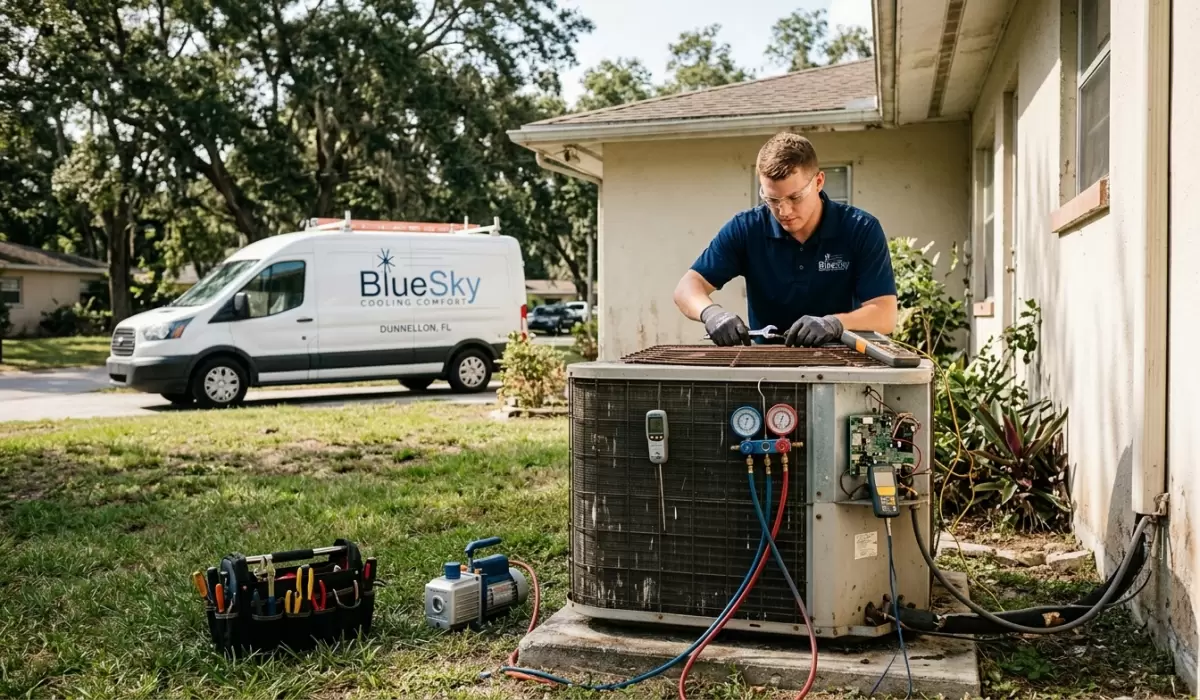
- An outdoor unit crusted in dirt, leaves, or bent fins
None of these are automatic no's. They're clues. A weak airflow problem might be a clogged filter or a failing blower. A musty smell could be a dirty coil or a drainage issue. The point is to know before closing, not after.
Check the ductwork, not just the box
In a lot of older Ocala and Citrus County homes, the equipment gets replaced but the ductwork stays. Leaky, undersized, or poorly sealed ducts waste the cooling you're paying for and leave some rooms hot no matter how new the unit is. If the attic is accessible, look for crushed flex duct, disconnected sections, or tape peeling off joints. Duct problems are common and fixable — but they belong on your list.
Ask for maintenance records
A system that got yearly service tends to run longer and cost less to keep. Ask the seller for records. No records isn't a red flag by itself, but it does mean you're buying an unknown. When there's no history, a pre-purchase HVAC inspection is money well spent.
Get a real inspection before you close
A general home inspector will flip the system on and confirm it blows cold. That's a start, not the whole story. It won't tell you about refrigerant charge, compressor health, coil condition, or how many seasons the unit realistically has left. That's what our techs check. We'll open it up, measure what matters, and give you a plain answer: good to go, budget for X, or plan on replacement soon.
That report gives you leverage. If the AC is on its last legs, you can negotiate the price, ask the seller to replace it, or plan your own installation with financing so it doesn't wreck your move-in budget.
What we'd tell our own family
Older homes are worth buying. Just don't let the HVAC be a blind spot. Know the age, know the refrigerant, know the condition of the ducts, and get a tech to confirm it before the ink dries. A little homework now beats a July no-cool call your first summer in.
Buying near Dunnellon, Ocala, Beverly Hills, or The Villages, FL and want a straight read on the system before you commit? Call us at (352) 362-8525 and we'll set up a pre-purchase inspection.